

In an era dominated by digital tools and automated tracking systems, the handwritten trading journal remains one of the most powerful yet underutilized instruments for developing trading discipline and consistency. The physical act of writing forces traders to engage more deeply with their decision-making processes, creating a level of accountability and self-awareness that digital platforms often fail to achieve. While modern trading platforms offer sophisticated analytics and real-time data, the deliberate practice of manually documenting trades creates a cognitive connection between action and reflection that fundamentally transforms how traders approach the markets.
The Cognitive Benefits of Manual Trade Documentation
The process of maintaining a handwritten trading journal engages multiple cognitive pathways that digital entry simply cannot replicate. When traders physically write down their trade details, market observations, and emotional states, they activate the reticular activating system in the brain, which heightens attention and improves information retention. This neurological advantage means that insights gained from writing are more likely to influence future trading decisions.
Research in behavioral psychology demonstrates that handwriting slows down the thinking process in a beneficial way, allowing traders to filter information more effectively and capture what truly matters. The deliberate pace of writing by hand creates space for reflection that typing on a keyboard does not provide. This measured approach helps traders identify patterns in their behavior that might otherwise go unnoticed in the rush of digital logging.
Memory Retention and Pattern Recognition
Studies show that handwriting improves memory retention by up to 34% compared to typing, a significant advantage when traders need to recall specific market conditions or emotional states that influenced past decisions. This enhanced recall becomes particularly valuable when reviewing historical trades to identify recurring mistakes or successful patterns. Understanding what makes a trading journal effective requires recognizing these cognitive advantages that manual documentation provides.
The physical connection between hand and paper creates a multisensory experience that strengthens neural pathways associated with learning. When traders review their handwritten notes weeks or months later, they often experience vivid recall of the circumstances surrounding each trade, including market conditions, personal emotional states, and the reasoning behind specific decisions.

Essential Elements of an Effective Handwritten Trading Journal
A comprehensive handwritten trading journal should capture both quantitative and qualitative dimensions of each trade. The quantitative elements include entry price, exit price, position size, stop loss level, and profit or loss in both dollar terms and percentage returns. These metrics provide the foundation for objective performance analysis over time.
However, the true power of a handwritten trading journal lies in the qualitative observations that traders document. These include the market conditions that prompted the trade, the specific setup criteria that aligned with the trader’s strategy, and most importantly, the execution quality rating. Rather than focusing solely on whether a trade was profitable, measuring execution quality reveals whether the trader followed their predetermined rules and maintained discipline regardless of outcome.
Pre-Trade Documentation
Before entering any position, traders should document their analysis and trading rationale. This includes:
- The specific setup that triggered the trade opportunity
- Technical indicators or fundamental factors supporting the decision
- Planned entry point, stop loss, and profit targets
- Position size calculation and risk-reward ratio
- Emotional state and confidence level on a numerical scale
This pre-trade documentation serves as a contract with oneself, establishing clear parameters that remove ambiguity during the heat of market action. When traders commit their plan to paper before execution, they create accountability that reduces impulsive decisions driven by fear or greed.
During-Trade Observations
Market conditions change rapidly, and documenting real-time observations helps traders understand how they respond to volatility and uncertainty. During active trades, traders should note any deviations from their original plan, including:
- Adjustments made to stop loss or profit targets and the reasoning
- Emotional responses to price movements
- External factors that influenced decision-making
- Temptations to exit early or hold beyond predetermined targets
These real-time notes become invaluable when reviewing trades later, as they capture the authentic decision-making environment that memory alone cannot preserve.
The Execution Quality Framework
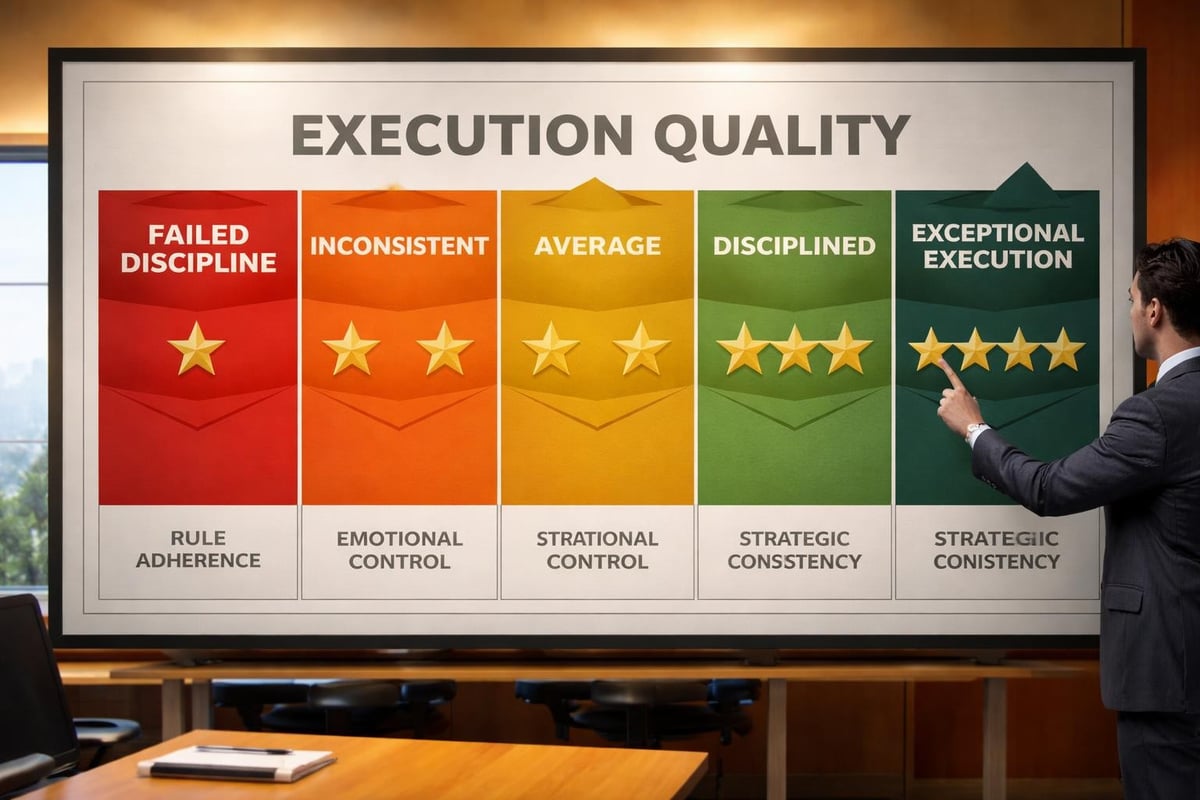
Traditional trading journals emphasize profit and loss, creating a results-oriented mindset that can undermine long-term development. A more effective approach rates each trade on execution quality using a standardized scale. This framework shifts focus from outcomes to process, recognizing that perfect execution can result in losses due to market randomness, while poor execution sometimes produces profits through luck.
A five-star rating system provides granular assessment of trade execution:
| Rating | Execution Quality | Criteria |
|---|---|---|
| 5 Stars | Exceptional | Perfect adherence to strategy, optimal timing, proper position sizing, emotional control maintained |
| 4 Stars | Strong | Minor deviation from plan, strategy followed, good risk management |
| 3 Stars | Adequate | Moderate rule following, some emotional interference, acceptable execution |
| 2 Stars | Poor | Significant rule violations, emotional decisions, risk management compromised |
| 1 Star | Failed | Complete breakdown of discipline, revenge trading, no strategy adherence |
This rating system, when documented in a handwritten trading journal, creates a performance metric independent of market outcomes. Traders can achieve high execution ratings even on losing trades, reinforcing the importance of process over results. Learning to stop revenge trading becomes easier when traders can visually see patterns of low execution ratings following losses.
Emotional Pattern Recognition Through Handwriting
One of the most profound benefits of maintaining a handwritten trading journal is the ability to track emotional patterns through subtle changes in handwriting itself. The physical characteristics of handwriting vary with emotional states: anxiety often produces tighter, more cramped letters, while confidence may show in bolder, more expansive strokes. Over time, traders can recognize these visual cues and correlate them with trading performance.
Recognizing emotional trading patterns becomes more intuitive when traders regularly document their psychological state before, during, and after trades. The handwritten journal creates a permanent record of emotional evolution, showing how confidence builds through consistent execution or how fear emerges after consecutive losses.
The Emotional State Inventory
Effective traders develop an emotional vocabulary that goes beyond simple labels like “anxious” or “confident.” A comprehensive emotional inventory might include:
- Physical sensations (tension, restlessness, calm)
- Cognitive states (clarity, confusion, racing thoughts)
- Behavioral urges (impulse to overtrade, desire to avoid screens)
- Confidence levels in the specific setup
- External stressors affecting mental state
When traders document these elements in their handwritten trading journal, they build a database of psychological insights that reveal which emotional states correlate with high-quality execution and which predict poor decisions. This self-awareness is fundamental to developing the emotional regulation skills that separate consistent traders from those who struggle with discipline.
Strategy Refinement Through Manual Analysis
A handwritten trading journal enables traders to conduct deep strategy analysis that reveals subtle patterns often missed in automated reporting. By manually categorizing trades according to setup type, market condition, and time of day, traders engage in active pattern recognition that builds intuitive understanding of what works in their approach.
The process of writing out trade details forces traders to confront uncomfortable truths about their strategy’s effectiveness. When losses accumulate in a particular setup category, the visual evidence on paper creates undeniable feedback that prompts necessary adjustments. Refining strategies through data-driven insights becomes more accessible when traders manually calculate success rates and average risk-reward ratios for different trade types.
Multi-Strategy Performance Tracking
Traders who employ multiple strategies benefit enormously from maintaining separate sections in their handwritten trading journal for each approach. This organization allows for direct comparison of:
- Win rates across different strategies
- Average profit per trade by strategy type
- Execution quality ratings for each approach
- Psychological comfort level with various setups
- Market conditions favoring specific strategies
This manual tracking creates a comprehensive performance database that guides resource allocation. Traders discover which strategies deserve more capital and attention versus those that consistently underperform or cause excessive psychological stress.
Building the Trading Playbook
The most successful traders eventually distill their handwritten trading journal into a personalized playbook that documents their A+ setups with precise entry and exit criteria. This playbook becomes the operating manual that guides all future trading decisions, eliminating ambiguity and reducing emotional decision-making.
Creating this playbook involves reviewing months of journal entries to identify the highest-probability setups. Traders examine trades that received five-star execution ratings and generated consistent profits, then document the common characteristics:
- Market Context: Trending versus ranging conditions, volatility levels, time of day
- Technical Setup: Specific indicator alignments, price patterns, support and resistance levels
- Entry Triggers: The precise signal that initiates position entry
- Risk Management: Stop loss placement methodology and position sizing rules
- Profit Targets: Take-profit levels based on technical factors or reward-risk ratios
- Execution Standards: The specific actions that constitute a five-star execution
This documented playbook transforms abstract trading concepts into concrete, repeatable processes. When new trade opportunities arise, traders simply match current conditions against their playbook criteria, removing subjective interpretation and emotional bias from the equation.
The Discipline-Building Effect of Manual Documentation
The requirement to physically write trade details creates a natural barrier against overtrading and impulsive decisions. Traders who maintain a handwritten trading journal report that the thought of having to document a rule violation serves as a psychological checkpoint, often preventing poor decisions before they occur. This pre-commitment device leverages loss aversion, as traders want to avoid the shame of recording undisciplined actions in permanent ink.
Understanding why traders break their own rules reveals that accountability systems like handwritten journals address the root causes of trading inconsistency. The physical act of documenting violations makes them concrete and undeniable, creating cognitive dissonance that motivates behavioral change.
The Weekly Review Ritual
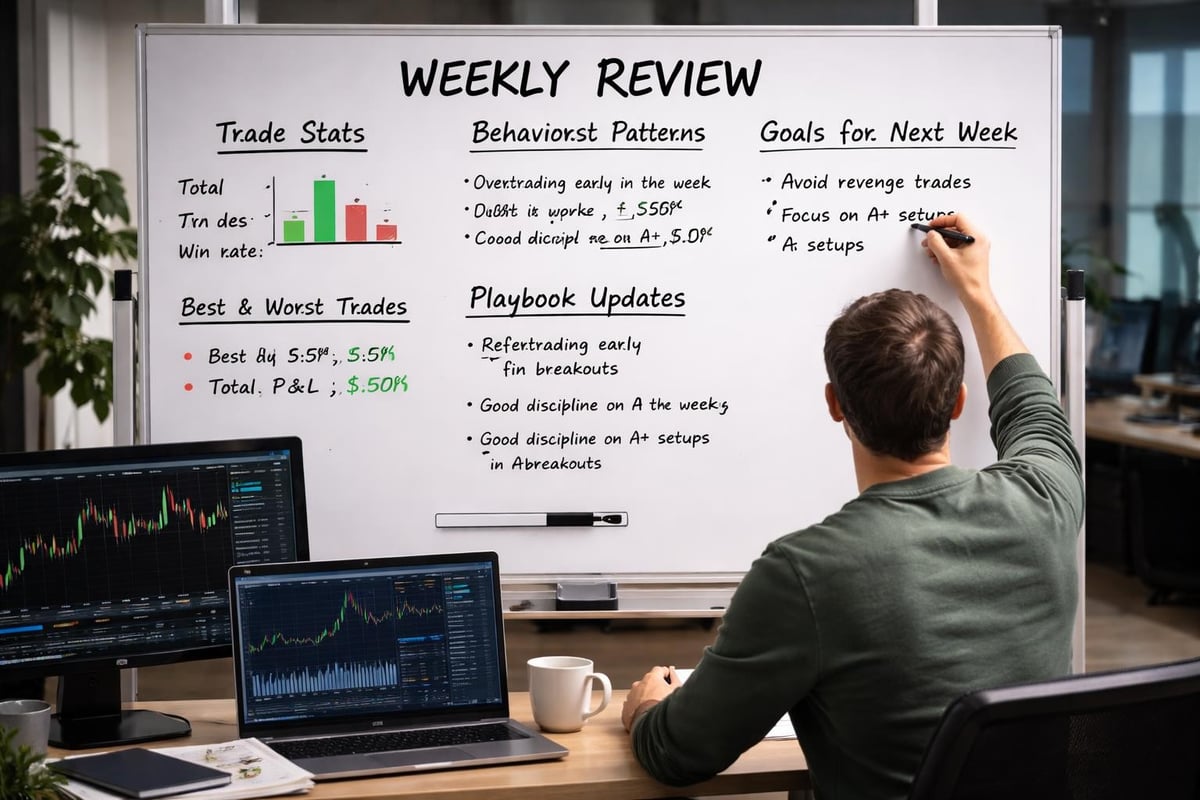
Maintaining a handwritten trading journal reaches its full potential through regular review sessions. Setting aside time each week to read through recent entries creates continuity between isolated trading sessions and reveals patterns invisible in day-to-day activity. During these reviews, traders should:
- Calculate aggregate statistics for the week (win rate, average risk-reward, execution quality)
- Identify the best and worst trades, analyzing what differentiated them
- Note recurring emotional patterns or rule violations
- Update the trading playbook based on new insights
- Set specific behavioral goals for the coming week
This review process transforms the journal from a passive record into an active development tool. Traders who consistently perform weekly reviews report significantly faster improvement in both execution quality and profitability compared to those who simply document trades without reflection.
Overcoming Common Resistance to Manual Journaling
Despite its proven benefits, many traders resist maintaining a handwritten trading journal, citing time constraints or preference for digital efficiency. These objections often mask deeper psychological avoidance, as writing forces confrontation with uncomfortable truths about trading performance and discipline.
The time investment required for manual journaling is actually modest when viewed through the lens of professional development. Documenting a single trade typically requires three to five minutes, a small investment that generates disproportionate returns in self-awareness and skill development. Recognizing the importance of emotional control helps traders understand that journaling time is not overhead but rather core skill-building activity.
Hybrid Approaches for Modern Traders
Traders who initially resist pure handwritten journaling can adopt hybrid systems that capture the cognitive benefits of writing while leveraging digital tools for analytics. This might involve:
- Handwriting qualitative observations and emotional states
- Using digital platforms for quantitative metrics and charting
- Scanning handwritten pages for long-term digital storage
- Maintaining a handwritten summary journal with detailed digital records
The key is preserving the deliberate, reflective quality that handwriting provides for the most psychologically significant aspects of trading while accepting digital assistance for routine data management.
Integration with Digital Trading Platforms
Modern traders need not choose between handwritten journals and sophisticated digital analytics. The most effective approach combines the cognitive benefits of manual documentation with the computational power of digital platforms. After completing handwritten documentation, traders can transfer key metrics into digital systems that generate performance reports, equity curves, and statistical analysis.
This integration creates a comprehensive feedback loop where handwriting builds awareness and discipline while digital tools provide objective performance measurement. Platforms like RuleBook.Trade complement handwritten journaling by focusing on execution quality metrics that align with the process-oriented mindset manual documentation cultivates.
The Long-Term Developmental Arc
Traders who commit to maintaining a handwritten trading journal for extended periods report transformative changes in their relationship with the markets. The accumulated pages of documentation create a tangible record of growth that builds confidence and resilience during inevitable drawdown periods. Looking back at early journal entries reveals how much skill and discipline have improved, providing motivation to continue developing.
Understanding how journaling boosts trading performance demonstrates that the benefits compound over time. Patterns invisible in short timeframes become obvious over months and years of consistent documentation. Traders develop intuitive pattern recognition that operates automatically during live trading, the result of thousands of handwritten observations that have trained the subconscious mind.
Milestone Documentation
Beyond individual trades, a handwritten trading journal should capture significant milestones in a trader’s development journey:
- First profitable month or quarter
- Achievement of specific consistency metrics
- Successful navigation of challenging market conditions
- Breakthroughs in emotional control or rule adherence
- Strategy refinements that produced measurable improvement
These milestone entries serve as psychological anchors during difficult periods, reminding traders of their capability and progress. The permanence of handwritten records gives these milestones special significance that digital notifications cannot replicate.
Advanced Techniques for Experienced Traders
As traders gain experience with handwritten journaling, they can incorporate advanced techniques that deepen insight and accelerate development. One powerful method involves pre-mortem analysis, where traders write detailed scenarios of how trades might fail before entering positions. This exercise identifies potential risks and emotional triggers that could compromise execution quality.
Another advanced technique involves documenting not just trades taken but also opportunities deliberately passed. Maintaining an effective trading journal includes tracking both actions and non-actions, revealing whether traders suffer more from overtrading or from excessive hesitation that causes missed opportunities.
Comparative Market Analysis
Experienced traders use their handwritten trading journal to conduct comparative analysis across different market environments. By categorizing market conditions (strong trend, weak trend, consolidation, high volatility, low volatility) and tracking performance within each category, traders develop nuanced understanding of their competitive advantages.
This analysis might reveal that a trader excels in trending markets but struggles during consolidation, suggesting capital allocation strategies that increase position sizes when favorable conditions emerge while reducing exposure during unfavorable periods.
Physical Format and Organization Considerations
The physical format of a handwritten trading journal significantly influences its utility and longevity. Bound notebooks with numbered pages prevent the loss of individual sheets and create a permanent, sequential record. Quality paper that resists bleeding ensures journal entries remain legible years later when reviewing historical performance.
Many traders prefer large-format journals that provide space for detailed notes, sketches of chart patterns, and comprehensive emotional inventories. Others favor pocket-sized journals that accompany them throughout the day, allowing real-time documentation of market observations and trading ideas. Choosing the right journal format depends on individual workflow and the level of detail each trader needs to capture.
Indexing and Retrieval Systems
As handwritten journals accumulate over months and years, developing an indexing system becomes essential for efficient information retrieval. Simple approaches include:
- Date ranges marked on notebook spines
- Colored tabs denoting different strategies or significant trades
- Summary pages at monthly intervals with key statistics
- Cross-reference systems linking related trades or patterns
These organizational tools transform the journal from a chronological record into a searchable knowledge base that traders can mine for specific insights when needed.
The Accountability Partnership Model
Traders can amplify the benefits of a handwritten trading journal by sharing entries with an accountability partner or trading mentor. The knowledge that another person will review journal entries creates additional motivation for honest, thorough documentation. This social accountability addresses the human tendency toward self-deception, as traders become more reluctant to rationalize poor decisions when they must explain them to someone else.
Regular accountability sessions where partners review each other’s journals generate fresh perspectives on recurring patterns. An external observer often identifies behavioral tendencies that remain invisible to the trader, accelerating the self-awareness development that journaling facilitates. Why every trader needs structured accountability extends beyond simple record-keeping to include regular review and external feedback.
Transitioning from Digital to Handwritten Documentation
Traders accustomed to digital journaling often experience initial resistance when transitioning to handwritten formats. The adjustment period typically lasts two to four weeks, after which the cognitive benefits become self-evident. During this transition, maintaining parallel systems (both digital and handwritten) can ease the shift while allowing direct comparison of the insights each method generates.
Many traders report that the transition produces immediate benefits in impulse control. The requirement to physically document trades creates a natural pause that interrupts automatic reaction patterns, giving the rational mind time to override emotional urges. This buffer effect alone justifies the additional time investment for traders struggling with discipline issues.
The handwritten trading journal represents far more than simple record-keeping; it is a professional development tool that builds the self-awareness, discipline, and process orientation essential for long-term trading success. While the digital age offers countless technological shortcuts, the cognitive benefits of manual documentation remain irreplaceable for traders committed to mastering both markets and themselves. Whether you maintain a purely handwritten system or integrate manual journaling with digital analytics, the key is measuring what truly matters: execution quality, rule adherence, and behavioral consistency. RuleBook.Trade provides the perfect complement to your handwritten practice with its focus on execution quality ratings, multi-strategy analytics, and A+ Setup Playbook features that help transform your handwritten insights into systematic trading excellence.

You might also like

Have you ever taken a loss, felt the frustration rise, and immediately placed another trade just to “win…
Discover why tracking your rule-following and discipline beats obsessing over P&L, and how a simple 1-5 star rating…

Why do traders break their own rules even when they know better?You build a solid trading plan. You…