

Unlock your trading potential in 2026 by harnessing the power of my trading journal. Most traders do not fail because of poor strategies but because they overlook the critical step of self-review. A well-maintained journal becomes your most valuable ally for developing discipline, consistency, and long-term profitability.
Imagine having a tool that uncovers hidden patterns, highlights your strengths, and exposes costly mistakes. This guide will walk you step-by-step through building, optimizing, and using my trading journal so you can trade with clarity and a proven edge. Ready to transform your trading results? Let’s dive in.
Why a Trading Journal is Essential in 2026
The trading world in 2026 is fast-paced and more crowded than ever. New markets, cutting-edge tools, and a flood of information compete for your attention each day. In this environment, having a clear process is vital. My trading journal offers that structure, helping you cut through the noise and stay focused on what truly matters.
Why Most Traders Lose, And How Journaling Sets You Apart
Research consistently shows that about 90% of retail traders lose money. The difference between those who succeed and those who fail often comes down to self-review. My trading journal is not just a record of wins and losses. It is a mirror, reflecting your habits, patterns, and decision-making over time.
Journaling forces you to confront your real results, not just your hopes or fears. By tracking each trade, you identify which strategies work and which lead to losses. This honest feedback loop is what separates consistent traders from those who repeat the same mistakes.
Building Discipline and Self-Improvement
Discipline is the backbone of long-term trading success. My trading journal acts as your personal coach, highlighting times when you followed your rules, and when you broke them. This level of accountability is essential for growth.
Top traders and professional prop firms require detailed journals for exactly this reason. They know that reviewing trades is the fastest way to spot emotional decisions, recurring errors, and missed opportunities. Whether you are a retail trader or aiming for a prop desk, this habit is non-negotiable.
Journals Reveal More Than Just P&L
Many new traders focus solely on profit and loss. However, this view is narrow. By using my trading journal, you can record emotions, execution details, and adherence to your trading plan. Over time, these notes reveal hidden patterns, such as trading out of boredom or chasing losses.
Modern journals, especially digital ones, allow you to go deeper. You can track rule violations, rate your execution, and analyze performance in ways that simple spreadsheets cannot. For an in-depth look at why execution quality matters more than profit, see this Execution quality in trading journals resource.
Human Review in an Automated Era
AI and automation are transforming trading, but human judgment remains irreplaceable. My trading journal empowers you to review trades with context, something algorithms alone cannot do. Combining data-driven insights with personal reflection ensures you adapt, learn, and stay ahead of the curve.
Consistency and Growth Through Honest Review
Consistency is impossible without structure. My trading journal gives you that foundation. By reviewing trades honestly and systematically, you turn every experience, win or loss, into fuel for improvement.
Journals are no longer just about logging numbers. In 2026, they are powerful decision-making and learning tools. With the right approach, your journal becomes the cornerstone of your trading edge.
Core Elements of an Effective Trading Journal
Unlocking the full power of my trading journal starts with understanding its essential building blocks. Whether you are a new trader or a seasoned professional, the structure and detail of your journal can make the difference between growth and stagnation.
What to Record: The Must-Have Data Points
To maximize the value of my trading journal, it is crucial to capture the right information for every trade. Begin each entry with the basics: entry and exit points, timestamps, and order types.
Document your trade rationale, noting the technical or fundamental signals that influenced your decision. Always record your risk/reward ratio, position size, and where you set stop-loss or take-profit levels. These details help you review your risk management process over time.
Equally important is tracking your emotional state before, during, and after each trade. This can reveal patterns of self-sabotage or hesitation. For instance, if you notice that anxiety before entries leads to premature exits, your journal will help you address it directly.
Finally, summarize the outcome and the lessons learned. This habit ensures that my trading journal becomes a true learning tool, not just a log of numbers.
Digital vs. Paper Journals: Pros, Cons, and Trends
Choosing the right format for my trading journal is a personal decision that impacts your workflow and discipline. Digital journals offer powerful analytics, easy searchability, and can integrate with platforms like TradingView. These features save time and allow for in-depth analysis.
Paper journals, on the other hand, encourage mindfulness and deeper reflection. Writing by hand can slow you down enough to process your thoughts and emotions more thoroughly. Some traders use a hybrid approach, combining digital speed with handwritten summaries for each session.
Recent surveys show that over 60 percent of modern traders now prefer digital solutions for their convenience and backup options. However, always consider security and data protection, especially when using cloud-based platforms. No matter the format, the key is that my trading journal supports honest, consistent, and actionable review.
Beyond P&L: Measuring Execution Quality and Rule Adherence
Profit and loss alone do not tell the full story of trading performance. My trading journal should track execution quality and rule adherence to provide an honest view of progress. Focusing only on profit can create false confidence and mask recurring mistakes.
A practical method is to rate each trade’s execution on a 1 to 5 star scale. This allows you to assess whether you followed your plan, entered at the right time, or hesitated under pressure. For example, two traders may have identical P&L, but the one with fewer rule violations is more likely to sustain success.
Documenting rule violations directly in my trading journal creates a feedback loop for improvement. By analyzing these entries, you can identify which rules are most often broken and why. For deeper insight, consider exploring the psychology and rule-breaking in trading, as understanding your mindset is key to long-term consistency.
Journals should highlight actions within your control, such as sticking to entry signals or avoiding revenge trades. This focus transforms my trading journal into a tool for continuous self-improvement and accountability.
RuleBook.Trade: The Execution-First Trading Journal Platform
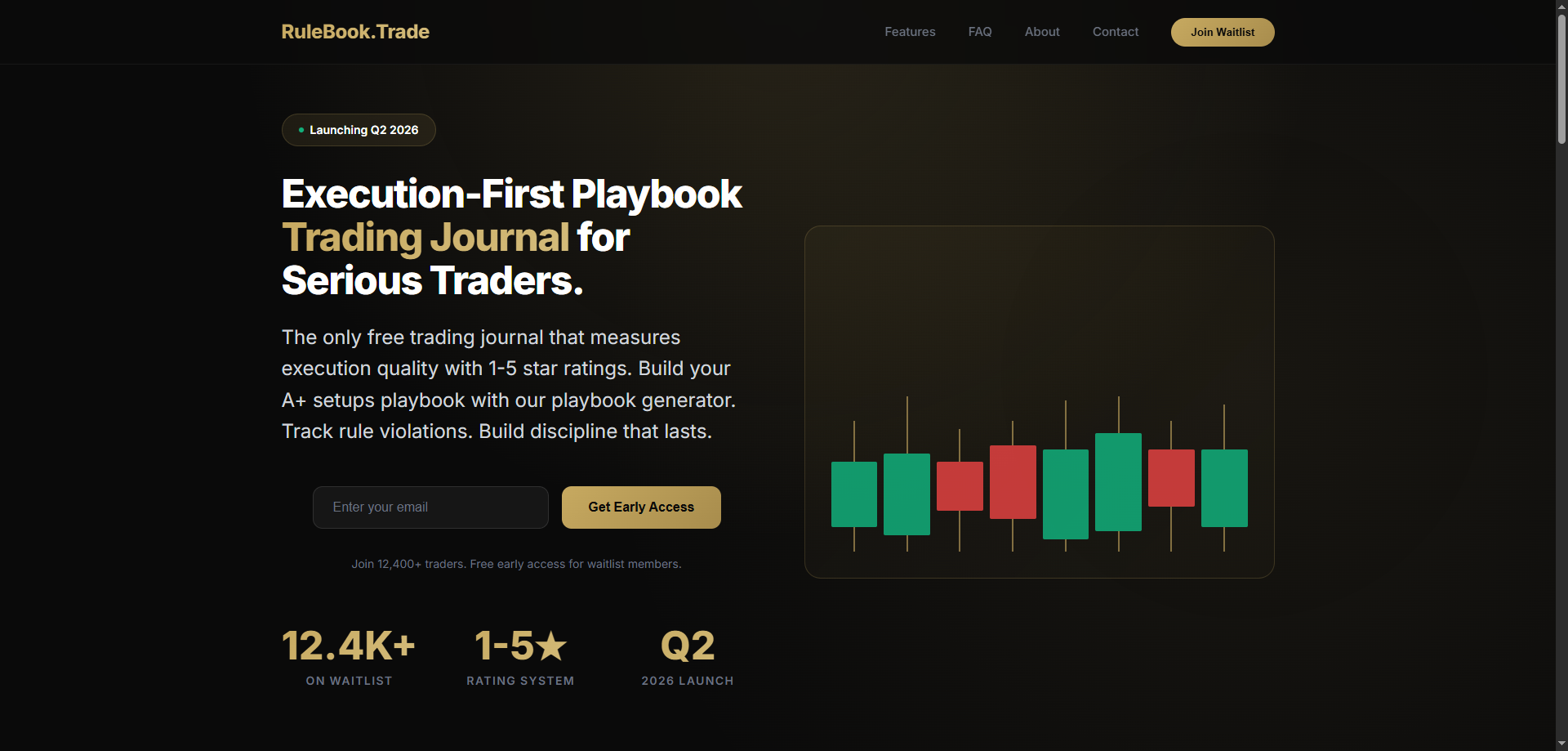
RuleBook.Trade is a digital platform launching in 2026 that takes my trading journal to the next level. Its core feature is a 1 to 5 star execution rating system, encouraging traders to prioritize discipline over mere profit.
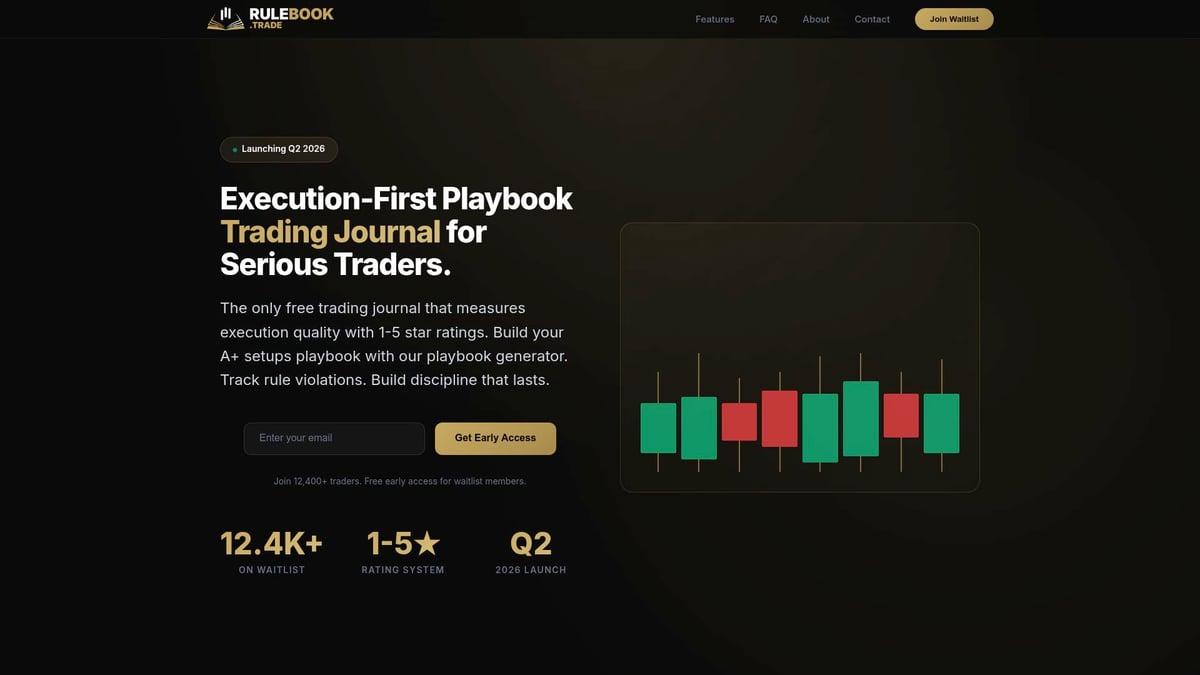
The platform offers multi-strategy analytics, allowing you to track different approaches and identify which ones deliver the best results. The built-in playbook generator helps you document and refine your A plus setups, turning your journal into a living strategy guide.
RuleBook.Trade integrates with TradingView, making it easy to attach charts and visuals directly to your entries. With multi-account support and a free plan for early adopters, it is designed for both retail and prop firm traders seeking structure, consistency, and growth in their trading journey.
Step-by-Step: Building Your Trading Journal for 2026
Creating my trading journal is the single most effective way to take control of your trading results in 2026. By following a structured process, you can turn raw data into actionable insights and ensure every trade moves you closer to your goals.

Step 1: Define Your Trading Goals and Rules
The foundation of my trading journal begins with clear, measurable goals. Are you aiming for steady monthly growth, capital preservation, or high-risk gains? Pinpoint your financial objectives and set your risk tolerance.
Next, outline your trading rules. This includes when you enter and exit trades, risk management guidelines, and which instruments you are allowed to trade. For example, a trader might set a rule to target 2 percent monthly growth while never risking more than 1 percent per trade.
Align the structure of my trading journal with these goals and rules. If your focus is on strict stop-loss adherence, ensure your journal template highlights this metric. By making rules explicit, you create a benchmark for honest self-review and improvement.
Step 2: Choose Your Journal Format and Tools
Choosing the right format for my trading journal is critical for consistency. Decide between a digital journal, a traditional paper notebook, or a hybrid approach. Digital journals offer analytics, multi-strategy support, and chart uploads, while paper journals encourage mindfulness and deeper self-reflection.
Consider these features:
- Analytics dashboards for performance tracking
- Ability to upload charts or screenshots
- Multi-account and multi-strategy support
- Integration with platforms like TradingView
Prop firm traders may require specific formats or fields, so check requirements before you commit. For some, a spreadsheet template may suffice, while others benefit from a robust platform.
For practical advice on setting up and maintaining your journal, review these Tips to Create and Maintain a Trading Journal.
Step 3: Create Your Trade Entry Template
A well-designed template is the backbone of my trading journal. Start with these essential fields:
- Date and time of trade
- Symbol and instrument
- Strategy and setup name
- Entry and exit prices
- Position size
- Risk/reward ratio
- Stop-loss and take-profit levels
- Trade rationale
- Notes on market conditions
Customize your template further with checkboxes for pre-trade checklists and post-trade reviews. Include fields for rule adherence, an execution rating, and psychological notes. For example, a trader might check off “followed pre-trade routine” or rate execution quality on a scale of 1 to 5. This structure ensures every aspect of your process is captured in my trading journal.
Step 4: Log Every Trade with Discipline
Consistency is the heartbeat of my trading journal. Log every trade in real time or immediately after closing the position. This habit ensures your records are accurate and your memory is fresh.
Be honest and thorough, especially when documenting losing trades. Avoid common pitfalls like backfilling trades, selectively logging only winners, or skipping entries during drawdowns. The value of my trading journal comes from capturing the full story, not just the highlights.
Traders who commit to disciplined logging often see measurable improvements. One case showed a trader’s win rate increased by 15 percent after just three months of consistent journaling.
Step 5: Review and Analyze Your Journal Weekly and Monthly
Regular review is where my trading journal transforms raw data into growth. Set aside time each week and month to analyze your entries. Look for patterns in your win rates, recurring mistakes, and rule violations.
Use analytics to track not just profit and loss, but also execution quality and adherence to your trading plan. For example, a monthly review might reveal that a particular strategy is consistently underperforming, prompting a necessary adjustment.
Updating your plan based on journal insights ensures you are always evolving as a trader. The review process is essential for making my trading journal a tool for continuous improvement.
Step 6: Adapt and Evolve Your Journal Over Time
As your experience grows, so should my trading journal. Add or remove fields as your strategies and insights mature. Seek feedback from mentors or trading communities to identify blind spots and refine your process.
Incorporate new learnings by updating your trading playbook and adjusting journal templates. For example, you might expand from single-strategy tracking to multi-strategy analysis as you diversify your portfolio.
Remember, my trading journal is not static. Evolving it ensures it remains your most valuable asset on the path to trading mastery.
Advanced Journal Techniques for Mastery
Elevating your trading performance in 2026 requires advanced techniques that go beyond the basics. By integrating these methods into my trading journal, you set the foundation for true mastery, ensuring your journal remains a powerful engine for learning and improvement.
Multi-Strategy and Multi-Account Journaling
As trading grows more complex, tracking multiple strategies and accounts in my trading journal becomes vital. You might trade stocks, forex, crypto, or options, each with distinct risk profiles and patterns.
A robust journal allows you to segment performance by strategy and account. For example, a trader managing both personal and prop firm accounts can compare results side by side. This clarity reveals which strategies consistently deliver and which need refinement.
Consider creating a table within your journal to summarize performance:
| Strategy | Account | Win Rate | Avg Reward:Risk |
|---|---|---|---|
| Breakout | Personal | 68% | 2.1:1 |
| Mean Revert | Prop Firm | 54% | 1.5:1 |
By reviewing my trading journal across various strategies and accounts, you gain insights into where your true edge lies. This approach supports data-driven decisions and continuous growth.
Integrating Chart Screenshots and Trade Visuals
Visual documentation is a game changer for my trading journal. Attaching pre-trade and post-trade screenshots from platforms like TradingView brings context to your written notes and helps you spot recurring chart patterns.
For each trade, include:
- A pre-entry chart with your setup marked
- A post-exit chart showing the outcome
- Annotations highlighting key decision points
This habit makes it easier to review not just the numbers, but the visual story behind each trade. Over time, you will identify which patterns lead to consistent wins or losses.
By consistently adding visuals to my trading journal, you transform abstract data into actionable insights. This process reinforces learning and accelerates strategy refinement.
Quantifying Execution Quality and Rule Violations
Focusing on execution, not just outcomes, is crucial for long-term success. My trading journal should include a system for rating trade execution, such as a 1-5 star scale or a checklist for rule adherence.
After each trade, ask yourself:
- Did I follow my entry and exit rules?
- Was my risk managed properly?
- Did I avoid emotional decisions?
Logging rule violations and rating each trade’s execution quality highlights patterns that pure P&L tracking misses. Over time, you can reduce errors by identifying common triggers.
For deeper improvement, supplement my trading journal with trading psychology resources, which support discipline and mindset. This combination strengthens your consistency and builds resilience.
Building and Maintaining Your A+ Setup Playbook
An A+ setup playbook is the secret weapon inside my trading journal. Document high-probability setups, including entry and exit criteria, annotated charts, and outcome statistics.
For each setup, record:
- The strategy name and market conditions
- Detailed rules for entry, stop, and target
- Screenshots of textbook examples
Review and update your playbook regularly using journal data. For example, if your “breakout pullback” setup shows a 70% win rate, prioritize it in your trading plan.
Maintaining a dynamic playbook within my trading journal ensures you focus on what works best. It streamlines decision-making and builds lasting confidence in your edge.
Turning Your Journal Insights into Trading Edge
Unlocking the full power of my trading journal requires more than just recording trades. The real edge comes from transforming raw data into actionable insights that drive measurable improvement. By systematically reviewing and analyzing your journal entries, you can identify hidden weaknesses, optimize your strategies, and reinforce habits that lead to consistent performance.
Identifying and Eliminating Costly Mistakes
One of the most valuable uses of my trading journal is uncovering patterns that lead to repeated losses. By tracking each trade, you can quickly spot emotional triggers, such as FOMO or revenge trading, that result in unnecessary risks. For example, many traders discover they lose more after a string of losses, often due to impulsive trades made in frustration.
To address this, use your journal to log not just the outcome, but the reasons behind every decision. Over time, these records reveal habits that sabotage your results. You might notice a tendency to overtrade after missing a setup, or to deviate from your plan when markets are volatile.
If you struggle with revenge trading, this guide on how to stop revenge trading offers practical steps you can document and monitor in your journal. By making these mistakes visible, you empower yourself to cut losses and develop more disciplined behaviors.
Optimizing Strategy and Risk Management
A well-maintained my trading journal provides the foundation for strategic refinement. By analyzing your win rate, risk/reward ratios, and expectancy for each strategy, you can pinpoint which approaches consistently deliver results and which need adjustment. For instance, you may find that your breakout trades outperform mean reversion setups, or that your position sizing is too aggressive in certain market conditions.
It is crucial to evaluate not just profits, but the quality of your setups and adherence to risk management rules. Use tables to compare strategies side by side, highlighting metrics like average return per trade and maximum drawdown. This systematic review allows you to make data-driven tweaks that improve risk-adjusted returns.
For more on evaluating systematic approaches, consider this study on the effectiveness of technical trading strategies, which underscores the value of careful strategy analysis, a process that becomes seamless with my trading journal.
Developing Psychological Resilience and Consistency
Trading success depends as much on mindset as on strategy. My trading journal is an essential tool for building psychological resilience. By recording your emotional state before, during, and after each trade, you can identify triggers that impact your decision-making. Perhaps you notice that poor sleep or external stress leads to impulsive trades and higher losses.
Use your journal to reflect on these patterns and set actionable goals for improvement. Over time, you will develop greater self-awareness and the ability to manage your emotions under pressure. Reinforcing positive trading habits, such as sticking to your plan and taking breaks after losses, becomes easier when you see the direct connection between your mindset and results.
Consistent journaling also helps you spot periods of overconfidence or fear, allowing you to adjust your behavior proactively. This ongoing feedback loop is key to achieving long-term consistency and growth.
Leveraging Analytics and Automation in 2026
The modern my trading journal is more than just a log, it is an analytics powerhouse. Advanced platforms now offer AI-driven insights, customizable dashboards, and automated alerts that highlight deviations from your trading plan. These tools help you visualize your performance over time, making it easy to spot trends, recurring mistakes, and areas for improvement.
For example, you can set up notifications for rule violations or track your execution quality with star ratings. Calendar views and heatmaps reveal when you trade best, while integration with charting platforms allows you to analyze setups visually.
Automation streamlines the review process, saving time and ensuring nothing slips through the cracks. By embracing these features, you turn your journal into a dynamic source of real-time feedback that sharpens your trading edge.
Continuous Improvement: The Feedback Loop
The true value of my trading journal comes from continuous improvement. Schedule regular review sessions to set monthly performance goals based on your journal insights. Share your findings with mentors or trading communities to gain fresh perspectives and stay accountable.
Consider creating a checklist of improvement actions after each review, such as refining your playbook, adjusting risk parameters, or focusing on specific setups. Over time, these incremental changes compound, leading to significant performance gains.
Remember, journaling is not a one-time task but an ongoing process. By regularly updating your journal structure and embracing feedback, you ensure that your trading evolves alongside changing markets and personal growth. This commitment to self-review turns insights into a sustainable trading edge.
Common Pitfalls and How to Avoid Them
Keeping my trading journal effective is about more than just recording numbers. Many traders fall into common traps that limit growth and insight. Recognizing these pitfalls is the first step to building a journal that truly elevates your trading performance.
Selective Logging: Recording Only Wins
One of the most frequent mistakes is logging only successful trades or those that feel “worth sharing.” This selective approach creates a distorted view of your actual performance. My trading journal should capture every trade, regardless of outcome. Omitting losses prevents you from identifying recurring mistakes or emotional decisions that need correction. For example, a trader who only logs profitable trades may miss a pattern of impulsive losses that erode overall returns. Full transparency is essential for growth and honest self-assessment.
Overcomplicating the Journal
Complexity can be the enemy of consistency. Adding too many fields, tracking irrelevant metrics, or designing elaborate templates often leads to burnout. My trading journal must remain simple and actionable. Focus on core data: entry, exit, rationale, risk, emotional state, and outcome. When the process becomes overwhelming, traders tend to abandon journaling altogether. Instead, start with essential elements, then add only what genuinely improves your review process. Simplicity fosters habit and long-term commitment.
Neglecting Regular Review and Analysis
A journal is only valuable if you revisit and analyze it. Many traders record trades but rarely review them, missing out on crucial learning opportunities. My trading journal should include scheduled weekly or monthly review sessions to spot patterns, rule violations, and emotional triggers. Without this step, valuable data sits unused, and mistakes are repeated. For instance, a trader who never reviews their journal may continue overtrading after losses, unaware of this destructive cycle. Consistent review is the engine of improvement.
Focusing Solely on Profit, Not Process
Profit is important, but it should not be your only measure of success. Journals that ignore rule adherence and execution quality fail to capture the full picture. My trading journal should highlight process, discipline, and decision-making, not just P&L. Assessing whether you followed your strategy or violated rules is key. As research on the Illusory Profitability of Technical Analysis shows, perceived success can mask underlying weaknesses if not critically reviewed. Documenting both wins and losses, along with the reasoning behind trades, leads to deeper insight and sustainable improvement.
Adapting and Evolving Your Journal
A static journal quickly loses relevance as your trading style matures. Failing to update templates, add new fields, or remove obsolete ones means missing out on valuable insights. My trading journal should evolve alongside your strategies and goals. For example, a trader who moves from single-strategy to multi-strategy trading will need to track performance across different setups. Regularly refine your journal structure based on feedback and results.
| Common Pitfall | Solution |
|---|---|
| Selective logging | Record every trade, win or loss |
| Overcomplicating the journal | Keep templates simple, focus on essentials |
| Neglecting review | Schedule regular analysis sessions |
| Focusing solely on profit | Track process, rules, and execution |
| Not evolving the journal | Update fields as your trading matures |
Practical Tips for Success
To avoid these pitfalls, remember: my trading journal is a living tool. Begin with the basics, review consistently, and adapt as you grow. Seek feedback from mentors or peers, and always prioritize honesty over ego. By making your journal simple, actionable, and review-focused, you set yourself up for continuous improvement and trading mastery.
Now that you’ve seen how a powerful trading journal can unlock discipline, consistency, and true growth, it’s time to put these insights into action. Imagine looking back at your trades with absolute clarity, spotting patterns you never noticed before, and refining your strategies with confidence. RuleBook Trade is designed for traders like you who want to measure execution quality—not just profits—and build a real edge in 2026. If you’re ready to take your trading to the next level, start building your own journal and experience the transformation firsthand.
Get Started

You might also like

Have you ever taken a loss, felt the frustration rise, and immediately placed another trade just to “win…

Why do traders break their own rules even when they know better?You build a solid trading plan. You…
Discover why tracking your rule-following and discipline beats obsessing over P&L, and how a simple 1-5 star rating…